



Property value influences selling plans, refinancing discussions, investment choices, and long-term financial decisions. Real Estate Valuation Services examine market evidence and property characteristics to develop a reasoned estimate. This process offers more context than selecting a price from nearby advertisements.
Homeowners often develop expectations through renovation costs, emotional attachment, or informal neighbourhood conversations. However, buyers compare available alternatives and recent transactions. Their decisions reflect current competition rather than the owner’s personal investment.
A useful valuation considers location, condition, size, design, improvements, and market activity. No single feature determines the complete result. The relationship between several factors creates a defensible value range.
Market value can also change over time. Financing conditions, local inventory, employment patterns, and buyer demand influence purchasing behaviour. Therefore, an old estimate may provide limited guidance for a present decision.
What a Property Valuation Actually Measures
A valuation estimates what a property may achieve under defined market conditions. It is not a guarantee that every buyer will offer the same amount. Individual motivations and negotiation terms can produce different outcomes.
The property’s location creates an important foundation. Access to employment, transportation, education, services, and recreation can influence demand. Street position, noise, views, and surrounding development may create differences within the same neighbourhood.
Physical characteristics also matter. Size, layout, age, condition, parking, outdoor space, and building quality affect buyer comparisons. Useful floor plans can sometimes command stronger interest than larger but inefficient layouts.
|
Valuation Approach |
Main Information Used |
Primary Strength |
Important Limitation |
|---|---|---|---|
|
Automated Estimate |
Public records, property data, and statistical models |
Provides a quick general indication of value |
May overlook condition, upgrades, and unique property features |
|
Comparative Market Review |
Recent comparable sales and active local competition |
Reflects current local market and buyer behavior |
Accuracy depends on the availability of suitable comparable properties |
|
Professional Appraisal |
Physical inspection, market evidence, and documented analysis |
Provides a detailed and independent valuation opinion |
Represents value at a specific assessment date |
|
Owner Estimate |
Personal knowledge, property history, and expectations |
Incorporates first-hand knowledge of the property |
May be influenced by emotional attachment or subjective expectations |
Recent comparable sales provide evidence of completed buyer decisions. Active listings show current competition but only reveal seller expectations. Pending transactions may offer useful direction when reliable information is available.
Valuation accuracy depends on selecting meaningful comparisons:
- Similar property type, size, age, layout, and overall condition.
- Comparable location, surroundings, access, and neighbourhood influences.
- Recent transaction dates that reflect current market behaviour.
- Verified features without assumptions about hidden improvements.
Adjustments may be necessary when no property offers a perfect match. The reasoning behind those adjustments should remain clear and proportionate.
Factors That Can Raise or Reduce Estimated Value
Valuation involves more than counting bedrooms and measuring space. Buyers evaluate how a property functions, how much work it requires, and how it compares with alternatives. Their priorities may change between market cycles.
Condition, Improvements, and Presentation
Well-maintained systems can reduce perceived risk. Roofing, heating, cooling, plumbing, electrical components, and moisture control often matter more than decorative trends. Deferred maintenance may cause buyers to reserve money for future repairs.
Renovations can add value, but their cost does not equal their market contribution. Quality, usefulness, permits, and local expectations influence the result. Highly personalised work may appeal to fewer buyers.
Presentation can affect sale performance without permanently changing underlying value. Cleaning, lighting, decluttering, and minor repairs help buyers recognise existing strengths. These steps may improve market response more efficiently than major renovations.
Accurate records strengthen the review. Sellers should organise permits, warranties, invoices, floor plans, and improvement dates. Documentation helps distinguish verified upgrades from general claims.
Market Conditions and Property Position
Supply and demand shape buyer leverage. Limited inventory can increase competition, while abundant alternatives may extend selling periods. Financing costs can also change how much buyers can comfortably offer.
Micro-location deserves careful attention. Similar homes may receive different interest because of traffic, views, lot position, or nearby land use. General area averages may conceal these differences.
The following process supports a balanced assessment:
- Confirm property facts through records and direct observation.
- Identify recent comparable sales with meaningful similarities.
- Adjust for condition, features, location, and market timing.
- Review current competition before establishing a value range.
A range often provides more honest guidance than one precise number. It acknowledges uncertainty while supporting practical pricing discussions.
Automated Estimates Compared With Detailed Assessments
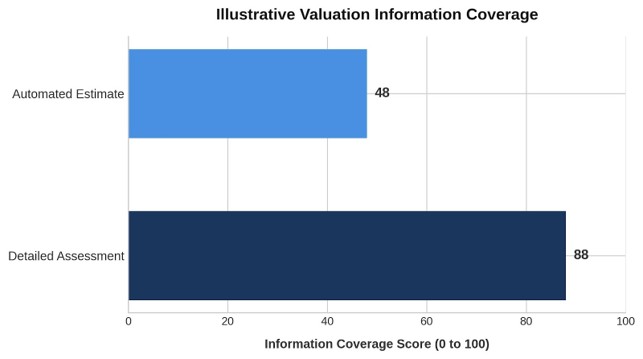
- Significant Coverage Gap: A Detailed Assessment achieves an information coverage score of 88 out of 100, capturing nearly double the relevant property and market factors compared to an Automated Estimate (48 out of 100).
- Scope of Automated Estimates: Automated tools rely primarily on public records and statistical modeling, offering a fast starting point but missing nuanced, property-specific data.
- Value of In-Depth Context: Detailed assessments integrate critical non-standard variables such as interior condition, layout quality, recent renovations, and exact street positioning.
Preparing for a More Reliable Valuation
Homeowners can improve the process by confirming basic property information. Lot size, living area, room count, parking, and renovation history should be accurate. Incorrect facts can distort comparisons from the beginning.
The property does not need to appear perfect, but access should remain practical. Important rooms, systems, storage areas, and exterior features should be visible. Hidden areas can limit the assessment.
Prepare supporting records before the review. Permits, plans, improvement receipts, rental information, association documents, and recent maintenance records may provide useful context. Only relevant and verifiable information should influence conclusions.
Owners should also explain unusual features without insisting on a predetermined value. A detached workspace, accessibility improvement, or specialised system may require additional market research. Its contribution depends on buyer demand.
Finally, clarify the purpose of the valuation. A possible listing price, insurance requirement, refinancing decision, or estate matter may require different methods. The intended use shapes the appropriate level of formality.
Using Valuation Evidence with Confidence
A credible valuation connects property facts with recent market behaviour. It considers physical condition, location, improvements, competition, and buyer demand. The conclusion should follow visible evidence rather than personal expectations.
Real Estate Valuation Services help owners understand both opportunities and limitations. They can reveal which features support value and which concerns may influence negotiations. This insight improves planning before important financial decisions.
Valuation should never be treated as permanently fixed. New sales, changing inventory, financing conditions, and property improvements can alter the picture. Updated evidence becomes necessary when circumstances change.
At William Reynoso, we believe the most valuable property estimate is not necessarily the highest one. It should be supported by relevant market comparisons, accurate property information, and transparent analysis. This reliable foundation helps homeowners make confident decisions about pricing, negotiations, refinancing, and future real estate planning.