



To sell the house, the first question to ask is: what does the property realistically worth? A property selling price estimate can help homeowners evaluate that question before listing, negotiating, or planning their next move.
A good estimate should take into account more than just square footage or recent sales in the neighborhood. The market value of any property can be impacted by its condition, location and upgrades, the buyer demand level and competing listings. Although two houses are similar, they might not sell for the same price.
The pricing of items can accelerate or slow sales down. If you set the price of the house too high, it may not sell. If you price it too low, you will leave money on the table. Because of this, homeowners need a broader view of the value rather than a quick guess.
A greater understanding of the likely selling range helps with planning. This helps sellers manage their sales expectations better and negotiate with confidence.
The factors that determine selling price
The market value of a property is the effect of several factors working together. There are physical factors and others which depend upon present behavior and local conditions. That’s why one single formula never gives the whole answer.
Location is still one of the strongest influences. Neighborhoods are often compared by buyers for schools, access, amenities, traffic patterns and appeal. Locations near to the area can therefore command different prices.
The state is also important. Home upgrades like kitchens, roofs, systems, and presentation impact buyer’s interest. Not every improvement delivers the same value.
Evolving comparable sales provide important evidence. This property needs to be similar in size, condition, street and features. When change happens fast, older sales aren’t as useful anymore.
|
Valuation Factor |
Limited Approach |
More Reliable Approach |
|---|---|---|
|
Comparable Sales |
One nearby sale |
Several recent similar sales |
|
Property Condition |
Basic visual estimate |
Detailed condition review |
|
Location |
ZIP code only |
Street, neighborhood, and surroundings |
|
Market Demand |
Ignored |
Current buyer activity considered |
|
Competition |
Not reviewed |
Active listings compared |
Considering all of these factors together give a better home value assessment. We're NOT looking for the one perfect number. Buyers need a more realistic price range for their home, supported by evidence.
How an Estimate That’s More Accurate Is Built
Great appraisals begin with the property itself. There should be careful documentation for size, layout, lot characteristics, number of bedroom, special features. Not all details are equally important.
Look at Similar Properties
Comparable sales are properties that recently sold under similar conditions to the subject home. They are often referred to as comps. The more similar the comparison, the more useful it is.
Effective comparisons often take into account the property type, location, living area, age, and condition. Due to features such pools, waterfront access, views or renovations, we may have to adjust.
Sellers ought to concentrate on
- Houses with similar features have sold recently.
- Real estate closest to the site.
- Sales performed under normal market conditions.
- Listings that reflect active buyer competition.
The analysis of home pricing should distinguish between sold homes and active homes. The buyer’s payment is shown by sold prices. Current seller pricing is reflected in active listings.
Accounting for property variations
Each property has its own unique traits. A home may have had an interior renovation, while another needs repairs. Another may possess a bigger lot or a more powerful view.
It is important to address these differences. Value of extra bedroom is not consistent through the every neighborhood? How much buyers will pay is determined by market preferences.
At another time. A sale that happened months ago may need some context if prices have gone up or down since. Variation in activity may influence seasons.
When local evidence backs these adjustments, the price estimate for property selling becomes more reliable. Try to minimize guesswork where possible.
Estimated Automation vs. Local Market Study
Using online valuation tools for a quick starting point can help. They use public records and prior sales and property information for estimating value. But machine minds apparently cannot adjust for recent renovations. Plus curbside variances.
Imagine a made-up house in which a kitchen has been renovated, flooring has been upgraded, and water-facing secluded view has been provided. An automatic estimate may correlate it to nearby homes of a similar size. However, those houses may not have the same improvements or view.
The differences may be accounted for by a local review. It can also determine if buyer demand is stronger for certain features. Incorporating human context can help us form a better price range.
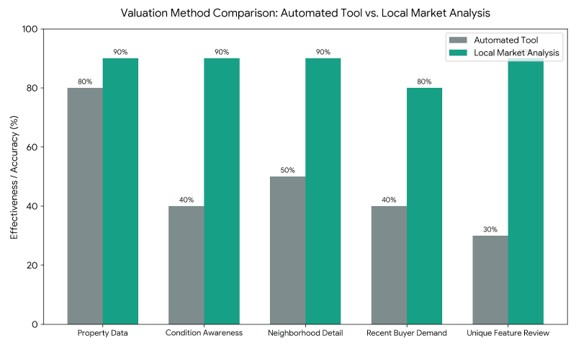
- Automated tools are quite efficient at gathering broad property data – 80% of the time. This is useful for establishing a range of values and should not be relied upon as the actual sale price of the property.
- Local market analysis is far better at assessing property condition (90%) and unique feature reviews (90%), compared with automated tools down to 40% and 30% respectively.
- The detailed local score does a better job of capturing hyper-local neighborhood detail and dynamics 90% of the time vs. 50% with automated platforms.
Steps to Take Ahead of Setting Your Asking Price
It is important homeowners gather accurate property information before listing price. This includes the square footage, improvements, permits, major updates, and unique features. Comprehensive information aids in improved comparisons.
Next, check out recent sales. Concentrate on homes with similar features rather than the high-priced one. Unusual sale could indicate abnormal market conditions.
It is crucial for the sellers to analyze the existing competition. Before submitting an offer, buyers often compare the active listings. If many similar homes exist, one may require a stronger positioning.
A good pricing preparation process may include.
- Verify key facts and improvements on property.
- Check out what’s recently sold and available.
- Check present demand and buyer competition.
- First choose a price range that is realistic.
We should also consider presentation. A property that is well-maintained will make a stronger impression than one that needs visible work. Buyers might not pay as much attention as vendor’s.
Finally, sellers should avoid emotion-based pricing. Sentimental value and renovation costs don’t always reflect the actual value of a house. Today's alternatives and perceived value, influence suppliers.
When you are disciplined, negotiation becomes easy. When sellers understand the evidence underpinning their price, they respond to offers more confidently.
Using valuation insight may help you get a better sale price
A well-considered pricing decision could impact every step of the selling process. It does influence how buyers engage, offer, negotiate, and how long it takes to secure one. That makes valuation an important first step.
An estimate of the selling price of your property will give the homeowner a better idea of where his property may stand in the market. It combines recent sale, condition, location, competition, and buyer demand.
The best estimate should be seen as a realistic range-not a guarantee. The final sale price will depend on actual buyers and market conditions can vary. You should be flexible throughout the listing period.
If activity is weaker than expected, sellers should reassess pricing. Changing the picture can be new competing listings or demand.
In the end, good pricing is about evidence, not hope. With guidance from William Reynoso, homeowners can better understand what affects property value and make more confident listing and selling decisions.